
Canceling Clovis
How a theory about New World colonization became problematic

Beyond debate
New World Indigenous origins have been hotly debated since Europeans first landed on American shores in the 15th century and the issue remains contentious today, to put it mildly. Early explorers grappled with reconciling their Christian faith with the newfound reality of Nations for which the Bible certainly did not account. These new “Indians” must have arrived in the recent past to remain consistent with the Christian Bible, and early theorists cited Genesis to conclude that American Indians were descended from a lost lineage of people dispersed from Babel around 2250 BC. Such explanations remain common among fundamentalist Christians today.
The Latter Day Saint Joseph Smith refined this notion by suggesting that the common ancestor of all American Indians, a Hebrew prophet, arrived by boat from Africa in 600 BC. The “Lamanites”, Smith recounted from his prophesy, were cursed by God with dark skin as punishment for their rebellion, and ultimately exterminated their close (and white) cousins the Nephites, who had become their sworn enemies since arriving to the New World.
As secular beliefs proliferated during the 19th and early 20th centuries, the explanations changed but the timeline remained roughly the same. Ales Hrdlicka, the curator of physical anthropology for what became the Smithsonian Institution, moved the discourse forward by arguing for an Asian origin for American Indians via the Bering Land Bridge. However, Hrdlicka’s timeline deviated little from those of religious timelines prior, and he hung onto his belief that American Indians arrived to the New World only 3,000 years ago long past the time that notion was proven false.
Anthropologists have accepted the Ice Age origins of American Indians only during the last 100 years, having been prodded by the discovery of the Folsom site in New Mexico in 1927. The Folsom discovery expanded the timeline for human occupation of the Americas four-fold and ushered in a revolution in scientific understanding about American Indian ancestry. The discovery was, in many ways, beyond debate, an obvious human-made weapon found lodged between the ribs of an extinct species of Ice Age bison.
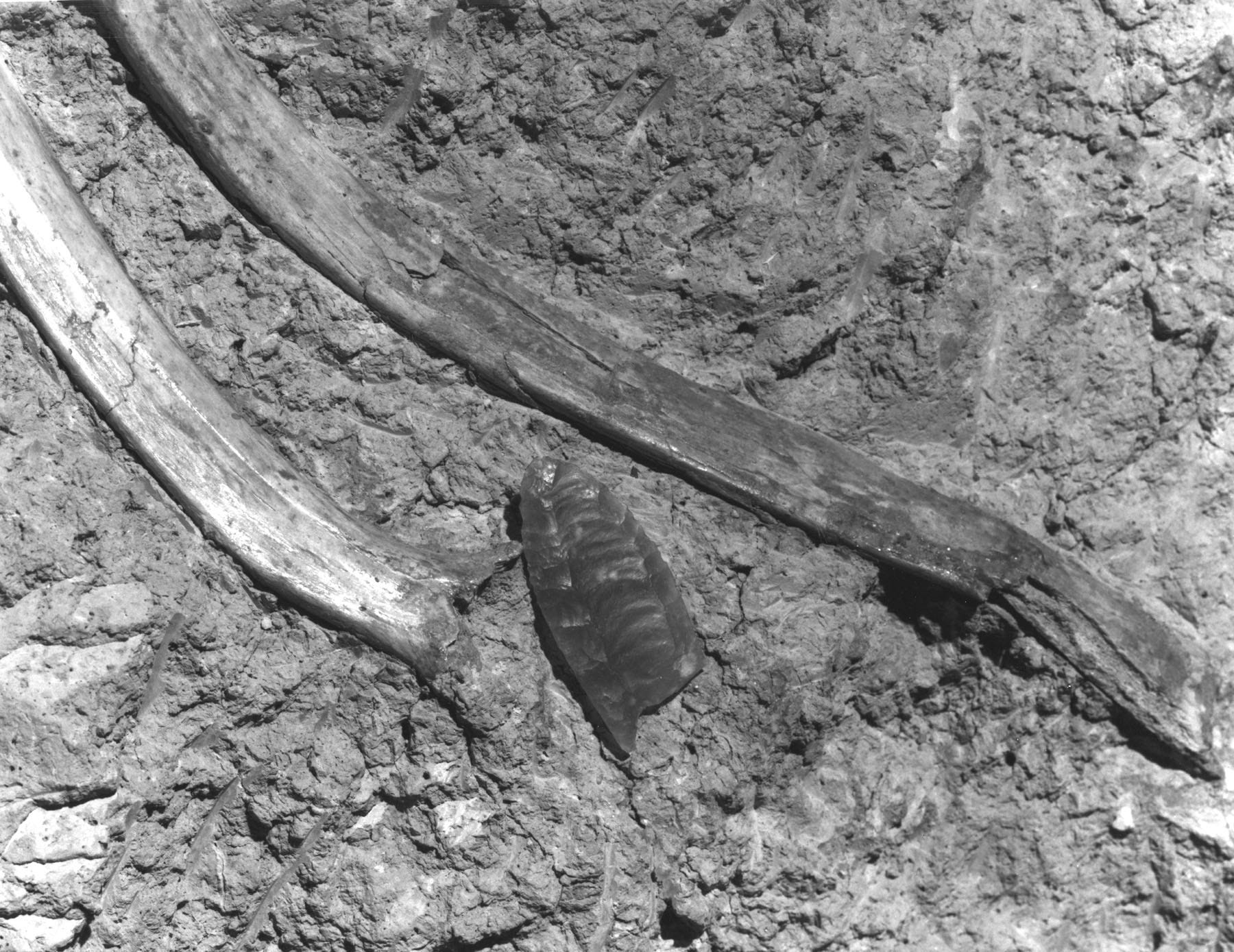
In retrospect, the Folsom discovery might have been the last time American archaeologists all agreed on something. Since then, New World colonization has been a hotly contested and sometimes acrimonious public debate. As of late, that debate has become laden with moralistic undertones, a shift that ensures one side is not only wrong, but morally corrupt for their beliefs. That tendency seems to grow worse each year. How did we get here? And how should the field get back to a place of mutual trust and, ideally, a shared paradigm for New World origins? Let’s start with Paleoindian archaeologists’ own origin story at the Clovis type site in New Mexico.
Clovis first
Blackwater Draw is today an unremarkable drainage dissecting the Plains of northeast New Mexico, one of many that slowly moves water toward the southeast across the pane-flat Llano Estacado. But as the Ice Age ended around 13,000 years ago, Blackwater Draw was an important oasis that provided a source of freshwater and forage for a menagerie of now-extinct animals like mammoths, horses, and camels, the so-called Pleistocene megafauna whose bones have been found scattered around the Draw in gravel pits since the early 20th century.
The site rose to national prominence in 1936 when Penn archaeologist Edgar Howard discovered large spear points in association with mammoth bones, the first evidence that humans had hunted these massive creatures in North America. Howard named the newly-discovered weaponry Clovis points after a nearby town, thereby establishing Blackwater Draw Locality 1 as the type site for what was then, and some say remains the oldest identified culture in the New World.
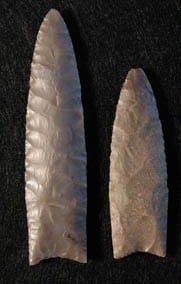
Clovis wasn’t always first. During the first several decades after the Blackwater discovery, North American archaeologists combed the continent for evidence that humans had arrived ever earlier than Clovis to the New World. There were strong contenders that never quite panned out, and everywhere archaeologists looked Clovis seemed to reign supreme as the deepest buried, rarest, most commonly associated with extinct fauna, and ultimately oldest archaeological culture in North America. But how much absence of evidence is necessary to prove evidence for absence? The Tule Springs site seemed to have the answer.
Tule Springs, an Ice Age fossil site outside of Las Vegas, Nevada, gave C. Vance Haynes the evidence needed to declare Clovis First for the first time. Here, Haynes established himself as godfather of what became known as the “Clovis mafia” by showing through a series of massive excavation trenches that Tule Springs, a rich desert oasis brimming with Ice Age life prior to 13,000 years ago, possessed no evidence for human occupation during that time. Ice Age humans, Haynes assumed, would have certainly been drawn to the Springs alongside herds of Pleistocene megafauna had humans been present at the time. But at Tule Springs, humans only appeared at the site after the extinction of North America’s megafauna, suggesting to Haynes that humans were not present in North America until the end of the Ice Age.
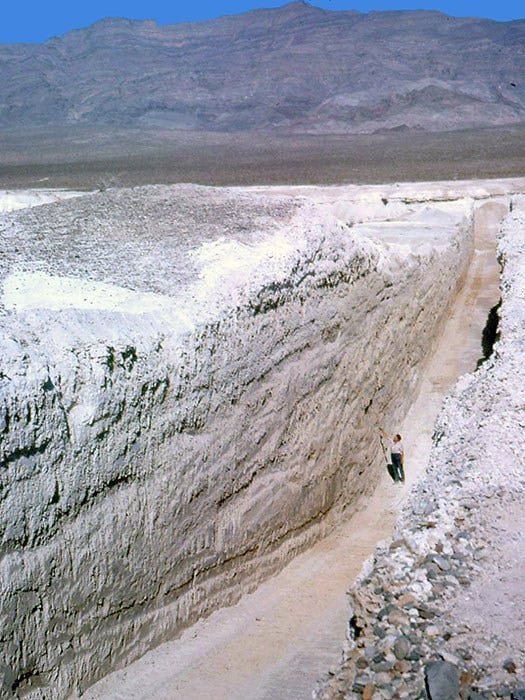
“Clovis first” emerged in private discussions long before being published, but it entered public discourse in 1964 when Haynes published Fluted Projectile Points: Their Age and Dispersion in Science. In the influential paper, Haynes presents the first radiocarbon dates (then a new method) on fluted point occupations spanning the contiguous 48 United States. Haynes demonstrates that Clovis points appear contemporaneously across a large swath of North America between 11,000 and 11,500 radiocarbon years ago and are without exception the oldest human occupations found in stratified archaeological sites. Haynes demonstrates a tight co-occurrence between Clovis and continental deglaciation, using this evidence to suggest a migration of Clovis foragers through an ice free corridor from Alaska. Notably, Haynes does not forcefully argue in the study that Clovis is definitively “first,” acknowledging “good indications that there were” earlier archaeological occupations from poorly-understood sites. However, he believes these occupations were sparse and do not represent an antecedent culture to Clovis.
Today, Clovis-first is tightly associated with the notion that the first Americans drove 36 megafaunal genera to extinction due to overhunting during colonization. That connection was first made by Paul Martin, one of Haynes’ major advisors, in a 1973 Science publication called The Discovery of America: The first Americans may have swept the Western Hemisphere and decimated its fauna within 1000 years. Martin presents a simple model using basic assumptions about human and wildlife population growth rates to argue that overhunting things like mammoths, horses, and camels was not only possible, but expected given their naivete to human predation. The close temporal association between megafaunal extinction and the Clovis phenomenon seemed to suggest a direct relationship.
By 1973, some sites with tentative evidence for older than Clovis occupations had been more critically investigated, and in all cases had turned out to be false. Accordingly, Martin makes a more forceful case that Clovis might indeed be first, stating in a memorable paragraph:
Invasion by a slowly growing and chronically sparse population is not impossible. But it requires major ecological constraints that have yet to be identified in the American environment. Given the biology of the species, I can envision only one circumstance under which an ephemeral discovery of America might have occurred. It is that sometime before 12,000 years ago, the earliest early man came over the Bering Straits without early woman.
Thus, Clovis First emerged in 1964, but it took shape as a unique identity within the archaeological community in 1973. Generally speaking, Clovis First includes beliefs that a) the first Americans migrated to North America via the Bering land bridge, b) they traversed an ice-free corridor from Alaska south into the remainder of the New World during continental deglaciation, c) Clovis is the first identifiable culture in the New World, and d) people used Clovis points to drive Pleistocene megafauna to extinction upon arrival. Case closed?! Not quite.
The Politics of Peopling
Opponents of Clovis First claim that it enjoyed over a half century of uncontested dominance in American archaeology, but the idea only remained popular for around 25 years before legitimate challenges emerged. Even at the height of its popularity, Clovis First was routinely questioned by pre-Clovis advocates, who posited a revolving door of sites contending for the title of “earliest in the Americas”. In response, Clovis First adherents published critiques that evaluated context, dating, artifact legitimacy, or other aspects of site integrity that called into question whether pre-Clovis sites were actually what they claimed to be. For a long time, no pre-Clovis site passed muster. Opponents of pre-Clovis became known as the “Clovis Mafia”, a derisive nickname for Clovis First academics who allegedly conspired to kneecap new discoveries challenging their archaeological supremacy. That debate largely remained in the pages of academic journals until 1995, when a radical voice contesting Clovis First entered the conversation and imbued it with moralistic undertones for the first time.
Vine Deloria Jr. was a Standing Rock Sioux and one of the most impactful American Indian scholars to ever live, having written 20 books and many more essays throughout his decades-long career. Deloria spent much of his life questioning scientific understandings of American Indians and their New World origins, and he was especially hard on anthropologists, whom he credited with the blame for harmful Federal policies foisted upon Native communities. His long legacy of scholarship culminated with his 1995 book Red Earth, White Lies, which I see as the first move towards politicizing debates about New World colonization.
From the perspective of anyone who studies the past through an empirical lens, Red Earth, White Lies is, frankly, bonkers. A brief list of Deloria’s claims include:
we live on a young earth of several thousand years
the Judeo-Christian biblical flood was a literal event corroborated in Native American oral histories
the Mormons basically got Native American origins right in their claim of an African origin
Darwinian evolution is a failed theory
Beringia never existed
there was only one ice age
humans and dinosaurs co-existed as recently as the 18th century
pilgrims witnessed mammoth living in the eastern United States during the 18th century
I first ran across these ideas in the Sunday school I attended as a child, a couple hours north of the courthouse where John Scopes was found guilty by the State of Tennessee for teaching evolution in 1925. Red Earth is essentially a co-option of conservative Christian tropes regarding young earth creationism written from the perspective of a Lutheran Sioux. But the larger message is that scientific understandings of the past had monopolized discourse about American Indians for too long. Why not take the discourse back by aggressively embracing a deeply conservative, Nationalistic vision for Native origins sure to draw clean lines between himself and the western scientific establishment?
The archaeological community of 1995 judged Deloria harshly for this book, so I don’t think Red Earth directly impacted the field in any meaningful way. Certainly, few rushed out to field test Deloria’s hypotheses. Joe Watkins, who would go on to become an influential Indigenous archaeologist and President of the Society for American Archaeology, spends most of his 1996 American Antiquity review of the book humorously debunking many of its core tenets, concluding that:
…the first time I read this book I was surprised that anyone with Deloria's credentials would produce such a volume, and thought that no one else would have been able to get Simon & Schuster to publish it.
Brian Fagan, the prolific archaeology textbook author, provides a pithier assessment in his 1995 New York Times book review:
In short, Red Earth, White Lies is historical nonsense.
Mainstream archaeology was obviously not pleased, and they had good reason to contest Deloria’s “ethnic pseudoscience”. However, some in anthropology, especially among its cultural practitioners, were sympathetic to its aims. In a 1996 review published in American Anthropologist, John Mohawk concludes that:
Vine Deloria Jr. is (obviously) not an anthropologist and feels no need to offer nine kowtows to the profession’s established order. His book will be read widely among Indians and others who are already alienated from the arrogant certainty with which some anthropological theories are argued….Deloria does not actually accuse anthropology of being Eurocentric, but his book rings with this as a subtext and the record certainly supports the accusation to a degree.
And even Joe Watkins, who was obviously skeptical of the book’s claims in a literal sense, ultimately give Deloria the benefit of the doubt, concluding after four readings:
I think I understand the point Deloria is trying to make, that the blind adherence to any 'religion', be it Christianity or Science, breeds fanatics who fail to see beyond their own belief systems and that is what is at conflict here - belief systems…..this book will force scientists to rethink their tenets, especially in the 'New World'. It is unfortunate that New World archaeology's 'culture of compliance'…places traditional religions against the religion of science by pitting the word of a traditional person against the word of an 'educated scientist'. Deloria, in his own inimitable style, has chosen to remind us that scientists must, through research and publication, convince the public - or at least converse with them.
Even if Red Earth didn’t directly impact the way North American archaeologists operate, it certainly influenced the larger postmodern cultural milieu of the mid-1990s, when questioning long-held scientific truths, power structures, and even the merits of rational inquiry itself was all the rage. In this way, Red Earth is largely responsible for marrying Clovis First to white, American, colonial establishment thinking for the first time, characterizing what was once a radical idea as a stuffy, outdated relic of the western academy. Prior to Red Earth, Clovis First was still ascendant in popular discourse. After Red Earth, Clovis First steadily declined in popularity and was increasingly tinged with accusations of outdated thinking. The door was open for new ideas, and the Monte Verde site stepped through in 1997.
Monte Verde
Chile’s Monte Verde site had been known to archaeologists since the late 1980s, but the 1997 publication of Monograph Volume 2 signaled its ascendance into archaeological fame. MV-II, as the locality was called, was deemed the first universally accepted pre-Clovis site in the New World by a cadre of Paleoindian specialists, a fact broadcast in every popular science outlet. Although the site was discovered, excavated, and reported by Tom Dillehay, David Meltzer took the reigns as the leader of a group of outside observers, who traveled to the site to give it their blessing. Even C. Vance Haynes signed on, at least initially. Accordingly, archaeologists trained after the mid-1990s were likely taught that Clovis First was over, having been replaced by a new pre-Clovis paradigm that extended New World colonization back to at least 14,500 years ago.
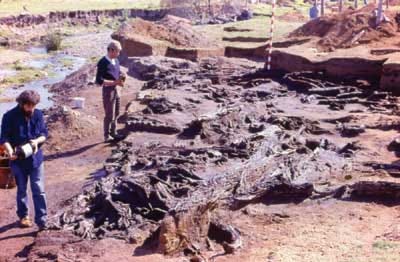
Monte Verde wasn’t just a new, slightly older site. It upended all aspects of the Clovis First paradigm. If humans arrived to the southern end of South America by 14,500 years ago, then there was no way they could have traversed to the Americas via terrestrial routes because there were still continental glaciers standing in the way. Thus, the idea that people colonized the New World via boats began to be taken more seriously. Moreover, the notion that people drove Pleistocene megafauna to extinction had to be abandoned, since human arrival would no longer coincide cleanly with megafaunal extinctions. Or as Meltzer and colleagues (1997) conclude:
While the MV-II occupation is only some 1,000 years older than the generally accepted dates for Clovis, the Monte Verde site has profound implications for our understanding of the peopling of the Americas. Given that Monte Verde is located some 16,000 km south of the Bering Land Bridge, the results of the work here imply a fundamentally different history of human colonization of the New World than envisioned by the Clovis-first model and raise intriguing issues of early human adaptations in the Americas.
A Post-Pre-Clovis World
At this point, in 2023, the pre-Clovis paradigm has spent as much or more time dominating archaeological discourse as Clovis First did. Since 1997, the list of widely accepted pre-Clovis sites has grown from one to at least a couple dozen, depending on who you ask. The coastal migration hypothesis has become the darling of popular science media, favored now over the ice free corridor, and Martin’s overkill hypothesis grows more unpopular all the time. To the layperson with a passing interest in New World colonization, it would seem as though Clovis First lost long ago.
Those few of us, like me, who remain committed to a Clovis First paradigm now seem hopelessly bound to a lost cause, like devoted militants holed up in a cave long after the war has ended. The Mafia remains today, but now seems less like a menacing threat than an aging Don perishing slowly in a white collar prison.
As Clovis First ages into senescence, the political divide created by Vine Deloria Jr. in 1995 has grown greater. The discourse has become, dare I say, something akin to cancelation, with Clovis First a colonial holdover that ignores Indigenous oral traditions and pre-Clovis a heroic progressive cause that acknowledges and validates them. The distinction is a uniquely American political construct, which I’ll call the “Deloria construct”, but it has nonetheless has been effective, having been picked up and disseminated widely by popular media. Reporting on the discovery of 23,000 year old footprints at White Sands, New Mexico in 2021, Nick Martin’s smug characterization in High Country News is demonstrative:
While it gives me great pleasure that [Clovis first has] now been proven wrong by their own cherished institutions, it remains an indictment of those same institutions that this Indigenous truth was ignored by non-Indigenous archaeologists for so long. Why is it so hard for an Indigenous truth to become an American fact? The White Sands discovery’s biggest accomplishment lies less in its scientific merits than in the way the fallout to the news highlights the lengths to which colonialist institutions — the academy, the scientific journal, the mainstream newspaper — will go to avoid conceding that their grand discovery is merely a physical acknowledgement of something Indigenous people have been saying all along.
The 2019 and 2022 publication of 16,000 year old artifacts from Cooper’s Ferry picked up on the narrative as well. Nez Perce Cultural Resource Program Director Josiah Blackeagle Pinkham is quoted by Oregon Public Broadcasting:
“It’s interesting to see how science backs up those types of [long-held tribal] claims,” Blackeagle Pinkham said. “New discoveries of old sites that show that we’ve [native tribes] been here for an incredibly long time.”
Likewise, Nakia Williamson-Cloud makes a direct connection between the Cooper’s Ferry artifacts and the modern Nez Perce in Science:
Although no genetic evidence connects the ancient toolmakers to modern Nez Perce people, Williamson-Cloud says he believes his tribe is “most definitely” their descendants. “These are truly our ancestors,” he says. “They aren’t just nameless Paleoindian people, and it’s not some nameless site. It’s a place where our lineage came from—people who are alive today.”
I honestly don’t understand this rationale completely, but to my eyes it goes something like: a) oral traditions state that Indigenous people have been on their modern lands since time immemorial, and b) 16,000 or 23,000 years is closer to ‘time immemorial’ than the meager 13,000 years associated with Clovis, so c) older sites more closely validate oral traditions. At least until an even older site pops up.
The most vocal advocate for the Deloria construct is Paulette Steeves, the author of 2021’s The Indigenous Paleolithic of the Western Hemisphere. Indigenous Paleolithic is a work of ethnic pseudoscience akin to Red Earth, and Steeves cites Deloria repeatedly in the book as a primary influence. Steeves is less hostile to science, but remains committed to the idea that it has been conducted at the expense of Indigenous oral histories about human origins in the Americas, with Clovis First chief among the offenders. Steeves has been on this beat since at least 2016, when she claimed in the Vancouver Sun that “the bias against pre-Clovis is so strong that many archeologists who found older sites and reported on them were academically destroyed” and that “archeologists invented a pan-hemispheric cultural group called the Clovis people. The Clovis people didn’t exist.”
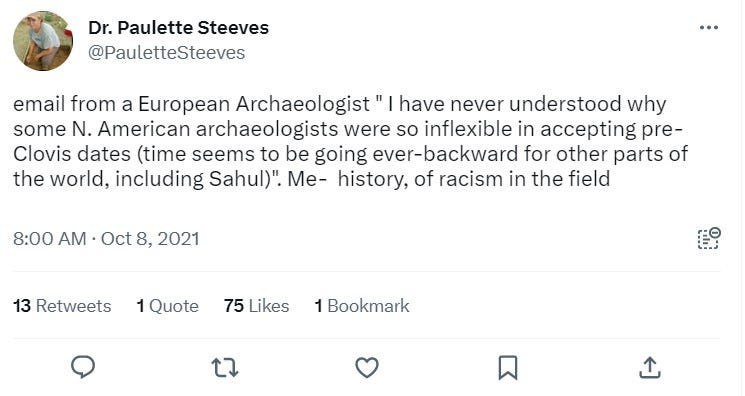
The irony is that 2023 opponents to Clovis First are at complete odds with those of 1995. Deloria contested Clovis First because he thought it was too old to conform with his young earth beliefs while Steeves thinks it’s too young to conform with her belief that Indigenous Americans have been in North America for over 100,000 years. That these disparate lines of reasoning are part of the same intellectual lineage is a testament to how convoluted the Deloria construct has become. Maybe I’m being a Goldilocks, but perhaps we should consider that Clovis First is neither too young nor too old, but just right.
Truth and Reconciliation
At times, it feels as though pre-Clovis adherents grew impatient with dragging the Clovis Mafia along to their side based on evidence alone, and instead decided to invoke identity politics to seal the deal. The “If you don’t believe me, you’re racist” defense so common today. I think this attitude is still largely confined to the most extreme pre-Clovis adherents, but I see it creeping further into popular discourse with each new discovery. It’s not productive, and pre-Clovis adherents would be well-served to distance themselves from that narrative before it inevitably turns on them. There is nothing inherently more or less pro-Indigenous to either worldview, and we should return to a time when we were simply arguing at conferences and in the pages of boring journals rather than attacking each other’s moral character.
As for me, I remain a dues-paying member of the Clovis Mafia and regularly visit to kiss the rings of those elders who came before me to chat about the good old days. Remember when Clovis First was considered a powerful validation of Indigenous heritage, extending claims to North America deep into the past? Now look at us. Stubbornly holding onto a tired story the American press abandoned long ago, and racist to boot.
In the end, the fact remains that no pre-Clovis site reaches the level of certainty obtained by the Blackwater Draw discovery 90 years ago. There are no stone spear points lodged between the ribs of a mammoth. There are barely any artifacts at all. It is, quite literally, a pretty shitty record. Nothing about pre-Clovis is beyond debate, and as long as there’s questions about the validity of The Current Thing, the Clovis Mafia will be here to ask them.
I really enjoyed this.
It also pretty much reinforces my belief that pretty much anything that has come out of the social sciences in the past 30 years that tickles the lefts political feelies is of pretty suspect merit because the academia hasn't been up to questioning leftist dogma for a long time.
As someone who dabbles in a lot of different fields, it is always amazing how every new discovery always confirms what everyone wants to hear. Every culture is older and more important and larger and more populace than previously thought. Which doesn't make sense since of a lot of the descriptions are relative. You end up in lake Woebegone where everyone is above average.
To answer your questions:
a) No, the genetic record emphatically does NOT suggest this. All mtDNA, yDNA, and autosomal data indicate a bottleneck followed by a rapid star-like radiation (expansion) sometime between 16,000-14,000 years ago. At 30,000, Native American ancestors had not yet diverged from other East Asians.
B) There is no evidence of any coastal adaptations between Kuriles/Sea of Okhotsk, kamchatka, Chukotka, or Alaska until the middle-late Holocene. All earlier cultures are terrestrial.
C) Recent meta-analyses of SOuth American data (see Prates, Politis and others) show while there 'may' be slightly earlier materials (depending on how one interprets the spotty record), there is clear indication of occupations after ~13,000 years ago - and a recent paper showed convincing brief overlap of Fishtail fluted point complex occupations and rapid megafaunal extinctions.
D) The genetics indicate a rapid, star-like spread and very large female effective population size. And, SNA is the only lineage found south of the ice sheets - and represents Anzick (Clovis) and all early individuals in both North and South America (these date between 12,900 and 9000 years ago.