

The McClung
The McClung Museum of Natural History and Culture opened in 1963 with the intent of curating and exhibiting research collections amassed by the University of Tennessee, Knoxville (UT). Today, their diverse collection includes Roman artifacts, historic maps and photos, over 300,000 malacological specimens, Chinese art, and an herbarium, among other collections dedicated to furthering University research and public engagement. But their most extensive collection is archaeological, which contains millions of artifacts and associated field notes, photos, and archival documents from decades of archaeological investigations across the southeastern U.S. It is among the most important archaeological collections in North America.
Until recently, a small portion of the McClung’s southeastern archaeological collection had been on display for decades, inspiring several generations of children to pursue careers in the ancient past. I grew up going to the McClung, as did a half dozen of my archaeological colleagues, each of whom attests to the McClung’s profound influence on their adolescent interests. The McClung, at least in the 90s and 2000s, punched well above its institutional weight, greeting visitors with a regal central atrium that led to a series of exhibition halls at once informative to the discerning visitor and engaging to the youngest. For a free museum in an Appalachian college town, it was a jewel.
Unfortunately, the last decade has not been kind to the McClung Museum, a story familiar to many cultural institutions. Pandemic closures in 2020 and 2021 combined with the rapid ascendance of radical leftist politics have been a toxic mixture for museums dependent upon in person visitation and tasked with “conserving” rather than “dismantling” collections. The McClung embodies this struggle well.
In 2021, the Museum began removing southeastern archaeology from their exhibition halls, repatriating their extensive southeastern collections, and transitioning their mission from curator of cultural heritage to curator of political rhetoric. Today, research on the McClung’s southeastern archaeological collection is prohibited and one can find no evidence for its existence at the Museum. Here, I piece together the events that led to the McClung’s rapid decline.
The Collection
The New Deal era (ca. 1930-40s) Works Progress Administration (WPA) conducted archaeological salvage excavations along the Tennessee River and its tributaries prior to inundation by hydroelectric reservoirs, recovering millions of artifacts later housed at the McClung. Most of these artifacts (around 90%) were recovered from sites inundated by Federally managed reservoirs (most commonly the Tennessee Valley Authority, TVA) and are held in trust by the McClung, meaning that decisions regarding their care are ultimately the Feds’. Artifacts recovered from privately managed reservoirs (like the Aluminum Company of America, ALCOA) are owned by the Museum, who is directly responsible for their care.
It is hard to overstate the importance of the New Deal excavations. Contrary to modern characterizations as glorified “looting,” the New Deal excavations pioneered many archaeological techniques still used today (Sullivan et al. 2011). Sites were horizontally gridded, artifacts cataloged to provenience, vertical control imposed to understand change through time, stratigraphic profiles site maps illustrated, field forms standardized, photographs collected in abundance, and investigations generally conducted in a way useful to archaeologists interested in understanding sites excavated almost a century ago. Stepping into a 1936 New Deal excavation block would likely feel familiar to archaeologists living today. The Federal government didn’t HAVE to do this, and indeed the TVA resisted excavations until political pressure forced their hand otherwise (Lyon 1996). The Feds instead paid poor young men with an aptitude for science to take up a shovel and start piecing together southeastern prehistory through sherds, animal bones, arrowheads, beads, and, fatefully, human burials.
New Deal archaeologists had a tight timeline for completing work ahead of the rising waters, so they did what any archaeologist might do: excavate the low hanging fruit. In the south, that fruit was mound-shaped and clustered in villages dotting high river terraces. There are thousands of “Indian mounds” in the southeast, and the auspicious features are a convenient way to find the region’s most significant archaeological sites, full of rare artifacts like stone pipes, beads, shell gorgets, and more often than not, human burials. New Deal archaeologists did not set out to recover 10,000 sets of human remains, but in their focus on large sites with the greatest potential to yield information they ended up with them anyway.
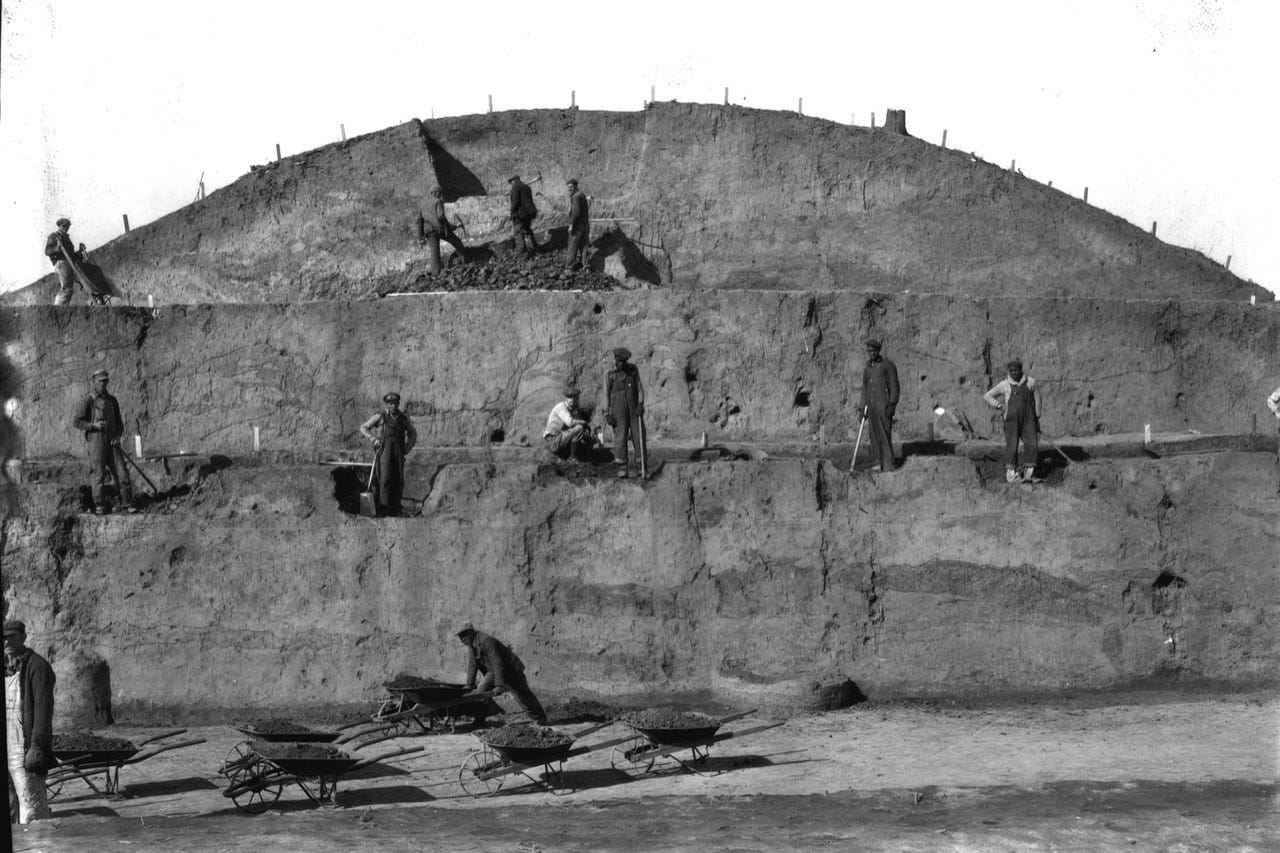
Large-scale reservoir excavations continued into the 1970s, well after the WPA had ceased to exist but within the era of TVA’s dam development, which ended with completion of the Tellico dam in 1979. Beginning with its founding in 1963, the McClung received many of the artifacts and archives from these salvage investigations. Since then, the Museum has slowly worked through the millions of artifacts, photographs, field notes, and human remains under their care, laying the foundation for UT’s archaeology research program and, eventually, the creation of a world-class museum exhibit featuring New Deal artifacts.
The Exhibit
The mountains of knowledge produced from New Deal excavations culminated in the exhibit Archaeology and the Native Peoples of Tennessee, which debuted in 2000. The exhibit was organized chronologically from Tennessee’s earliest “Paleoindians” to the Historic era Cherokee, featuring key artifacts from each era, informative placards, and realistic, ceiling-high watercolors depicting every day life in the prehistoric southeast. It was, in my opinion, the greatest exhibition of southeastern archaeology to ever exist and among the best North American prehistory exhibits north of Mexico.
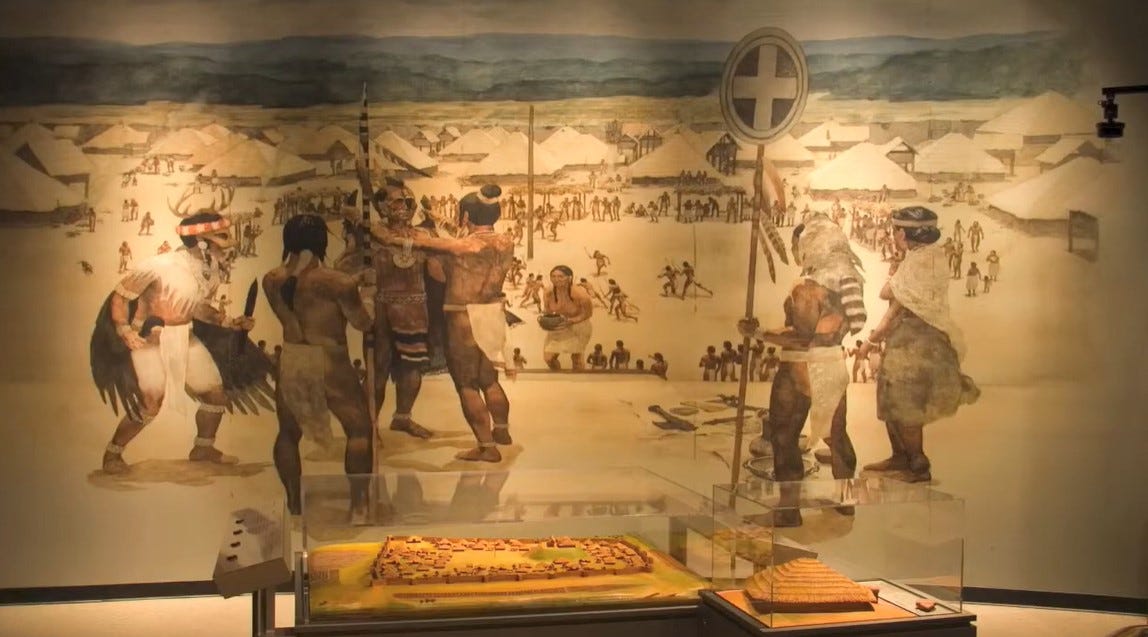
The Eastern Band of Cherokee Indians (EBCI) was integral toward exhibit development. UT and the McClung maintained a longstanding relationship with the EBCI, hiring a small crew of Tribal members for the Tellico Reservoir project to assist with burial excavations and then repatriating those burials to the EBCI for reburial in the early 1980s, almost a decade prior to NAGPRA. The McClung continued this legacy in 1997 when they invited the EBCI on as consultants for Native Peoples. Importantly, the EBCI gave their blessing to display a rich array of funerary objects as a means of fostering an appreciation for ancient Tennessee cultures to the wider public. These were the decorative shell gorgets, carved stone pipes, and whimsically molded ceramic vessels that have come to define the material culture of southeastern mound builders in textbooks and popular imagery.
The grand opening of Native Peoples was reserved for EBCI members, whose consultation work and ancient cultural history made the exhibit possible in the first place. The experience was positive enough that many stuck around for the public opening later that day. They were, after all, the stars of the show.
Despite this positive legacy of Tribal engagement, UT had problems. Decades of artifact collection resulted in millions of unprocessed artifacts and thousands of human burials that had yet to be inventoried for repatriation after 2010 regulatory changes that required they be. Most of these problems, to be clear, were not within UT’s power to resolve, having accepted collections from Federal agencies since the beginning that had yet to comply with their own laws themselves. Regardless, it was a bad look, a look that misinformed media outlets and activists were eager to pounce upon. Something had to be done.
The Unraveling
The beginning of the end for southeastern archaeology at the McClung occurred in the mid-2010s alongside increasing scrutiny of UT’s compliance with the Native American Graves Protection and Repatriation Act (NAGPRA). UT was not blameless in this regard. At an institutional level, UT was behind in their NAGPRA compliance largely due to the Department of Anthropology, who maintained their own archaeological collections independent of the McClung. Chief among the offences were remains collected by avocational archaeologists in the 1960s and 70s later donated to UT and a large collection of human remains amassed by the legendary forensic anthropologist William Bass, who had brought to UT in the early 1970s a large collection of Native midwestern burials. Many of Bass’s remains in particular were from relatively recent burials with known Tribal affiliation that should have been repatriated long ago, though the Smithsonian can take the blame for many of these (more on this later).
In response, the UT Department of Anthropology hired a collections manager to sort out the mess in 2016, Ellen Lofaro. Lofaro would later be promoted to UT’s Director of Repatriation in 2020, a position that appears to have been created specifically for her. As Director of Repatriation, Lofaro was under the direct supervision of the Provost, who allowed Lofaro and the “NAGPRA Committee” for which she took the reins greater leverage over UT collections than available within the confines of the Department. At present, that committee is comprised of an historian, 2 biological anthropologists, the McClung Museum Director, a paleoethnobotanist, an English professor, and UT’s Director of biosafety. Importantly, the committee contains only one southeastern archaeologist, paleoethnobotanist Kandace Hollenbach.
The committee began their work reasonably enough in the late 2010s by posting Notices of Inventory Completion to the Federal Register for the most obvious regulatory violations, starting with avocational collections and continuing with Bass’s. Soon thereafter, however, the committee turned their sights toward the McClung, and things started getting messy.
Hints of things to come began to emerge in 2018, when the McClung removed 23 known funerary objects from display as part of a specific NAGPRA case. The retirement of long time Director Jefferson Chapman in 2019 opened the door for new leadership with different views regarding the value of archaeological collections. Over the next several years, the Museum worked with the NAGPRA committee to audit Native Peoples, identifying 283 additional funerary objects or objects for which there were uncertain provenance. These objects were removed in December 2021 and replaced by small placards explaining their absence after consultation with eight Tribes, effectively removing over a quarter of the artifacts from Native Peoples.
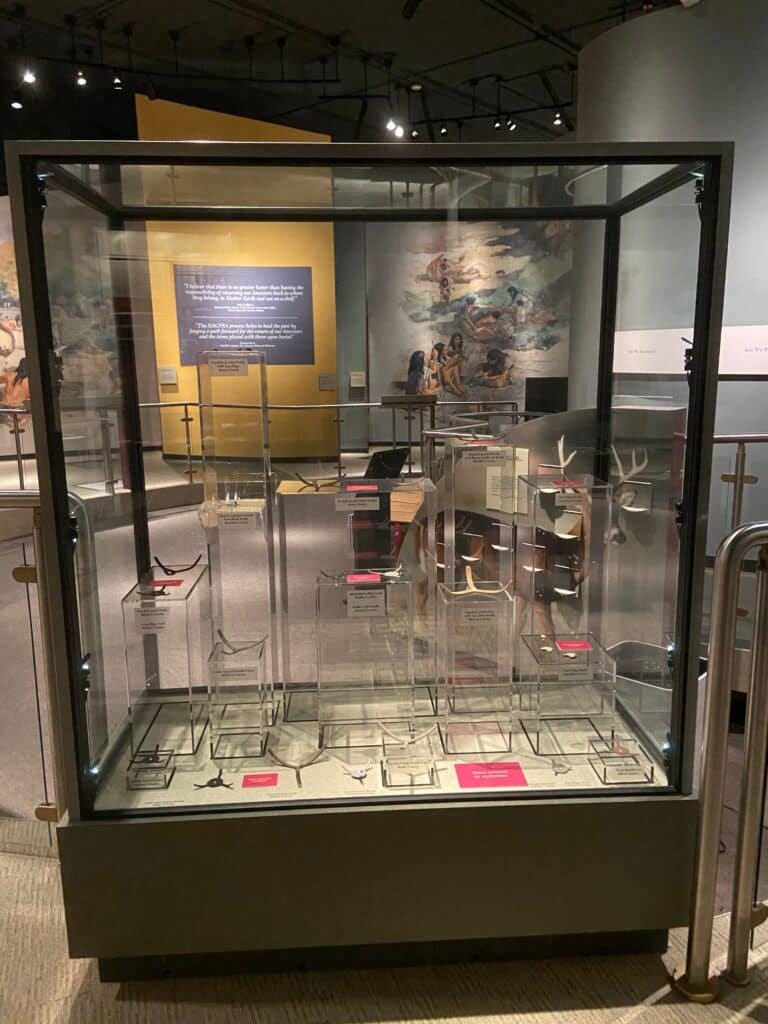
Removal of these objects was not necessarily a fatal blow to Native Peoples. There remained non-funerary objects on display along with educational placards, audio and video displays, murals, and the overarching exhibit infrastructure to sustain its educational value. However, the NAGPRA committee and their allies at the McClung were only getting started.
The McClung took this process further by removing or obscuring content that displayed “knowledge that the Museum wasn’t supposed to be sharing.” Using that standard, all content depicting pre-Contact Native American burial or sacred customs were either removed or obscured by drapes, things like photographs of mound excavations and line drawings of human remains.
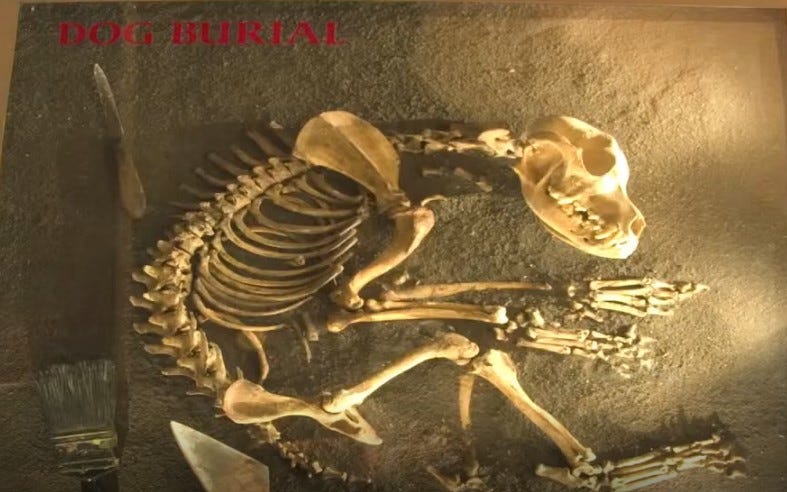
As a notable example, one display removed by the Museum recreated a dog burial using the skeleton of UT emeritus zooarchaeologist Walter Klippel’s deceased pet in lieu of archaeological skeletal remains. It was a poignant depiction of the long-lasting relationship between man and man’s best friend that bridged the modern and ancient in a moving, and to some, inspiring manner. Popular science educator David Ian Howe cites the display as an inspiration for his interest in “Ethnocynology”, or the study of dogs in a cultural context, an interest that grew into a successful popular science media brand. Of the dog burial display, Curator Sadie Counts says:
“the burial knowledge is not knowledge we can share. So even though this is a facsimile, it still references original knowledge that we [the museum] weren’t supposed to be sharing.”
With over a quarter of artifacts removed and a large portion of the remaining content obscured, the Museum was left with the shell of an exhibit. What, then, could they do with Native Peoples? Throughout the early months of 2022, Museum staff transitioned Native Peoples from an exhibit about archaeology to one about repatriation. They renamed the exhibit, barely, to The Repatriation of…Archaeology and the Native Peoples of Tennessee and lazily modified the signage by pasting a new line of text to the top of the gallery entrance. Repatriation of…. opened on August 23rd, 2022.
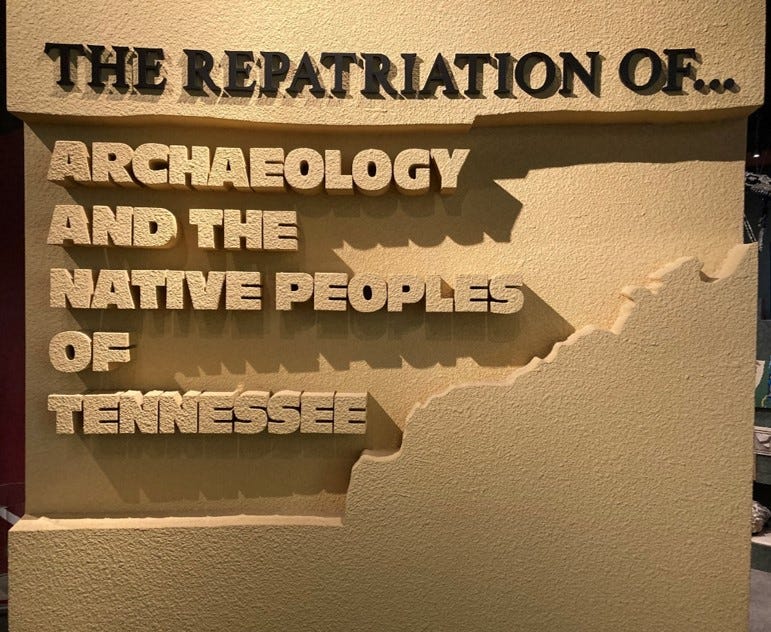
I should be clear. Repatriation of… was primarily just placards placed in empty display cases decrying the harmful legacy of museums, and especially the McClung. You can read them here. Bewilderingly, the McClung also removed a long-standing, universally beloved Egyptian exhibit in 2022 and a popular exhibit on Knoxville’s Battle of Fort Sanders in 2023. It’s worth asking what a visitor to the McClung Museum in 2023 would have actually seen other than cliche political messaging about “past harms” with which they were already inundated on their social media feeds. Why bother leaving the house for it? It seems apparent that others felt the same.
The Reaction
Throughout the 2000s and 2010s, former McClung Director Jefferson Chapman produced annual reports summarizing Museum activities, detailing temporary exhibits, budgets, new employees, and importantly, visitation numbers. Between 2010 and 2019, the McClung saw between 34,000 and 64,000 visitors per year, averaging 43,000. Coinciding with Claudio Gomez’s Directorship in 2019, annual reporting mostly stops, with one in 2020 announcing the museum’s pandemic closure and turn toward progressive policies and another in 2023. Thus, reporting for the 2020s is sparse, but according to their 2023 report the McClung has seen between 6,000 and 25,000 visitors per year during the 2020s, averaging around 17,000. In other words, the museum has experienced a roughly 60% visitation decline since 2019. Not great.
I am willing to entertain the notion that visitation declines are due to a post-COVID disinterest in “real life” experiences, especially those that require parking on a busy University campus. The early 2020s forced institutions everywhere to devise ways of virtually connecting to their clientele, and the McClung was no different. Why herd the family to the Museum when you can just tune into their YouTube channel? A general decline in museum visitation may be partly to blame, but it is obvious that visitor experiences declined as well. If online reviews are any indication, visitation declines seems to coincide closely with declines in user experience.
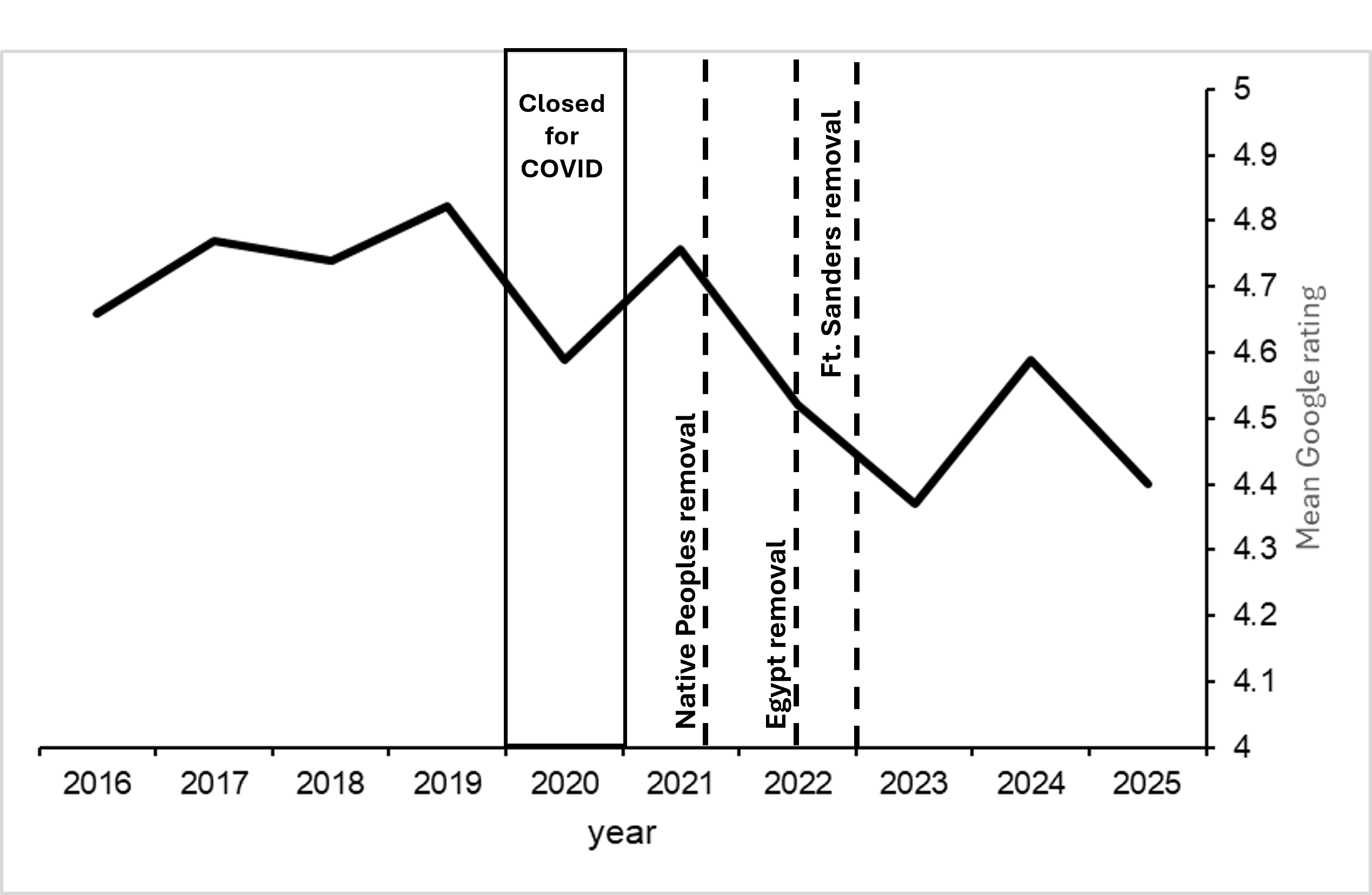
I compiled over 400 Google reviews for the McClung between 2016 and 2025, noting the number of stars (1 through 5) for each and general themes for visitation experience. The most highly rated year during this interval was 2019, when the McClung received an average rating of 4.82 stars. The 2020 pandemic year aside, all years between 2016 and 2021 were decent and relatively stable. That trend changed in 2022, and by 2023, an increasing number of highly negative reviews dropped the McClung’s mean rating to 4.37 stars, roughly where it remains today.
A brief look at negative reviews makes it clear where blame lies:
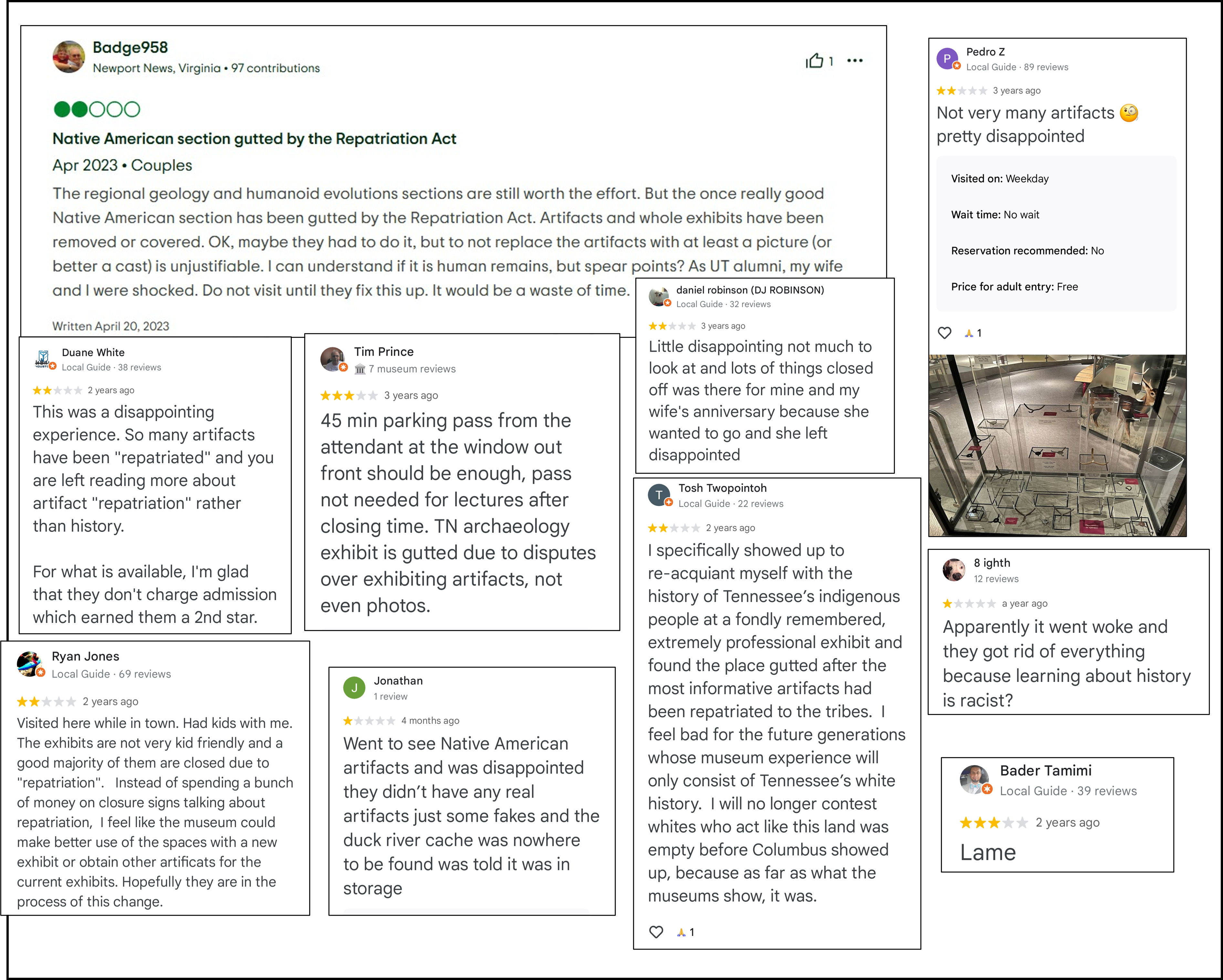
Removing Native Peoples was obviously not popular among Museum visitors who visited specifically for that experience. People who go to museums to see artifacts get annoyed when they find display cases filled with political messaging instead. I find it easy to believe that a museum stripped of its star exhibits simply isn’t much of a draw.
Here’s the counter argument: So what? The McClung does not charge admission and relies on memberships, donations, and (for the most part) State tax dollars to sustain its 19-person staff. As of 2019, the last time it was reported, over 70% of the McClung’s budget was obtained directly from UT. In this light, it matters little how many people attend the Museum annually nor how good of a time they have once arriving. That reality certainly seems to have landed with the McClung’s current staff, who treats the Museum more like a laboratory for experiments in Museology than a much-beloved institution. As Curators Shteynberg and Counts quipped to Humanities Tennessee:
“I’ll know that the work is important because it will make me nervous. I think that our work should make us a little bit nervous because it pushes us into new territory that we didn’t know was even there.” Counts concurred, adding that “we at the museum have to anticipate that we will change in ways we can never know until we get there.”
Perhaps that unknown territory is populated with record-setting visitation by people who leave with smiles on their faces. But perhaps it is mostly vacant besides a small group of self-congratulatory social justice activists, clinging bitterly to vogue ideas of the early 2020s. “We can never know until we get there,” except that this risky sojourn into the unknown is largely funded by Tennessee taxpayers, some of whom care how their cultural institutions are managed. The McClung’s most recent experiment in museum management, Homelands, is a good indication of the destinations to come.
Homelands
Repatriation of… was displayed for around a year and a half before closing in December 2023 in preparation for a new exhibit. The space once occupied by Native Peoples reopened in January 2025 to feature Homelands: Connecting to Mounds Through Native Art. The exhibit features contemporary Native American art related to the rich history of mound building in Tennessee, a topic once represented in that space by artifacts from the mounds themselves.
Homelands is the culmination of the McClung’s Curator of Cultural Collections Sadie Counts’ (2025) dissertation, entitled Going Home: Repatriation, contemporary art, and Indigiqueer futures in museums. Counts’ dissertation is exactly as edgy as one might expect from a PhD chaired by a cultural anthropologist currently suspended for celebrating Charlie Kirk’s murder, subversive as an asymmetrical haircut. Going Home is a queer critique of patriarchal heteronormative institutions (i.e., museums) that advocates transitioning museums into sites of revolutionary decolonization action, each a small contribution to destabilizing the power structures of imperial states. Counts outlines her vision for Homelands in the concluding chapter:
“…the museum can be read as a site of Indigiqueer futurity through both art and exhibition. It opens up these Indigiqueer futures and possibilities through notions of dreaming, and what I posit as curatorial dreaming, as manifested through the exhibition Homelands: Connecting to Mounds through Native Art. The museum is a site that allows for the queering of temporality, as the past and future are always collapsing in on one another, fucking each other to create new possibilities, new temporalities that defy our present reality.”
And here I was thinking museums store old stuff and inspire children.
Homelands was co-curated by four Tribal Nations with historical connections to east Tennessee and a small army of white women employed by UT. It features artwork produced solely by seventeen Native artists, an effort to “Indigenize” a once colonized museum space. Each Tribe chose several works of art that best represent their relationship to mounds and placemaking, ranging from hand woven basketry to large oil paintings.
At the request of their Tribal consultants, the McClung does not allow photos of Homelands nor have they compiled an exhibition catalog, so it is difficult to assess its content from afar. Images of Homelands published by the McClung are sparse, but at least a couple of the Homelands pieces I’ve been able to view remotely are seriously really nice. I am especially fond of Muscogee artist Jon Tiger’s “Sacred Birds of the Mississippians”, which depicts the extinct Ivory-Billed woodpecker perched beside a broad southeastern river. I was drawn to archaeology in large part because I love Native North American artistry, and that remains true for contemporary art as well.
The issue is, of course, that the McClung is not an art museum. It is a museum of natural history and culture. Sure, contemporary art is also “culture”, but then again so is a discarded bag of McDonald’s trash or a 1966 Ford Mustang, both symbols of culture in their own way. The entire point of curating museums is to make good decisions about what material culture should fill the space between their walls, and I think transitioning the McClung into a contemporary art museum is a bad curatorial decision. Knoxville already has a pretty great art museum. What Knoxville does not now have is a place to exhibit its deep human history.
A “Terrible History”?
Homelands co-curator Lisa King, a UT English professor of “Indigenous rhetorics” and NAGPRA committee member, claims in coverage by the Appalachian Voice that “UT has a terrible history when it comes to working with Indigenous peoples” and that they were “way behind” on their NAGPRA compliance obligations. This narrative in large part provided the justification needed to transition the McClung from an Institution devoted to preservation and education to a radical political project. Is it actually true?
By any factual account of the McClung Museum’s history, they did alot of things right. Artifacts housed by the McClung were mostly (90%) amassed by the Federal government with the Museum providing the infrastructure needed to house those artifacts and an enormous amount of financial support to deal with them. Although the salvage excavations of the 1930s and 1940s are now characterized as “looting” by King and those like her, they were actually among the most progressive gestures of their time, enacted to preserve Native culture in the face of Euro-American industrialism. In this regard, New Deal archaeology may even be characterized as an early form of “decolonization” itself, or at least colonial mitigation. By the 1970s, the EBCI even assisted with the task. Those efforts gave voice to the ancient people of the Tennessee River Valley who would have otherwise been silenced by the rising waters of southern reservoirs.
In instances where the McClung obtained control of human remains that could realistically be affiliated with modern people, specifically the EBCI, they began returning those remains for reburial on Cherokee lands well before NAGPRA required they do so. They maintained this relationship into the 1990s, when the EBCI were key consultants in developing Native Peoples, agreeing to allow the display of funerary objects to better tell the story of Tennessee’s human past. I would hardly characterize this history of Indigenous collaboration as “terrible.”
Even some advocates for closing Native Peoples acknowledge the closure was largely due to shifting cultural norms between the early 2000s and 2020, when, inspired by false narratives like King’s, a radical strain of decolonization took hold in activist communities. What happens when sentiments change yet again in 20 years? When the next generation realizes the value of museum collections once more, having moved past very bad ideas like “museum decolonization”? Will the next Lisa King bemoan the “terrible history” of Indigenous collaboration of the early 2020s, when radical activists from UT and southeastern Tribal leadership collaborated to erase the southeast’s human past from the McClung? Tragically, there will be no undoing the misguided actions being taken today when these realizations occur.
The McClung is but one part of the story regarding UT’s recent foray into radical decolonization, which has reached its art and research collections in addition to the McClung. These are public investments collectively worth tens of millions of dollars (hundreds?) spent over close to a century. The destruction of a comparably-sized investment to, say, Neyland Stadium would certainly raise a few eyebrows on the Board of Trustees, but no word from them yet. Fortunately for this newsletter, UT’s leadership has done nothing to mitigate the infiltration of its institutions by people devoted to dismantling them from within, providing me with a wealth of batshit crazy stories to cover. I’ll get to those in the coming weeks. In the meantime, please share this widely, and if you’re in Tennessee let your legislators know you care. Our museums need you more now than ever.