
The Pre-Clovis Caliphate
How I feel about the Monte Verde controversy

Henry from Hanna
There’s this guy from Hanna, Wyoming (pop. 683) that’s been contacting me every few months for several years now. Let’s call him Henry. Henry’s got something BIG to show me. He knows what he has.
So I politely call back. Henry’s usually out of breath and sounds busy, like he’s in the middle of changing a tractor tire. He breathlessly tells me about the stone age artifacts he’s found, older than anything I’d ever seen. Neanderthal. Maybe even Ah-choo-lee-anne. Henry’s done the research. He says they’re all up high in the uplifts and mountains where they lived when Wyoming was covered by a massive inland sea.
“I’m happy to take a look at them and let you know what I think,” I typically say. “I’ve already shown these to some ‘archaeologists’ in Casper,” he responds sarcastically. “They didn’t know what they were talking about.”
We hang up and he inundates me with text messages for an hour. Image after image after image depicting thousands of rocks neatly arranged in rows on a pickup truck tailgate. Crushed beer cans and yard toys litter the driveway in the background.
I usually repond by saying something like “those are really interesting rocks, but I don’t think they’ve been modified by humans” or “frost can fracture rocks in really odd ways.” He doesn’t like this, which leads to another round of appeals. Closeups of key features and stones held in hand showing how “they fit just right.” Side by side comparisons of rocks and images of saber-toothed cats and mammoths, obviously ancient sculptures. “I’m just not seeing it, sorry,” I reply.
By now, the guy is usually agitated enough that I get a follow up phone call. “You don’t know what you’re talking about”, “You’d have to be crazy not to see how this is manmade”, and my favorite….“let me just come to your office and show you.” Given the drug consumption habits of guys like this, I dodge the office visit.
I have maybe a half dozen guys like this in my life (always guys). Curious. Creative. Interested in knowing more. But also drug addled. Mentally unstable. Diagnosably delusional. Henry from Hanna is several years deep into an alternative world of his own creation, aided by a small community of yay-sayers, internet algorithms, and heaping piles of amphetamines. He’s an increasingly common type of guy, trolling social media groups, contacting their local “professionals” with pleas to be taken seriously, going on the Joe Rogan Experience, and, I must admit, getting PhD’s and publishing in peer-reviewed journals.
Monte Verde
Recently, a study by Surovell and colleagues challenged the age of the Monte Verde II site, from “pre-Clovis” in age to maybe 8,000 years old, and brought the world’s Henry’s from Hanna out of the woodwork, turning erstwhile studious academics into conspiracy-brained Facebook aunts. Those readers unfamiliar with the controversy can read about it here or watch videos about it here, here, and here. Suffice to say, those invested in a pre-Clovis age for the site are not happy. Not just not happy, but furious in the same ways Henry from Hanna gets when I express skepticism about his neat rocks.
The true believers, a group of early American specialists from half a dozen U.S. Universities, were 3 decades deep into a reverie of certainty regarding the pre-Clovis origins of people in the Americas, a reverie largely inspired by Monte Verde’s acceptance in 1997. They piggy-backed off Monte Verde with a revolving door of dubious pre-Clovis archaeological discoveries. Some stuck around, like Paisley Caves and Page-Ladson, but most have been quietly scrubbed from maps depicting “pre-Clovis” sites in the New World upon further scrutiny (see figure below). They developed entire theoretical paradigms like coastal migration to explain the site, launching a largely fruitless, decades-long search along the Pacific coast and beneath its waters for hints of Pleistocene coastal settlements. They courted big money donors and endowed faculty devoted solely to the pursuit of pre-Clovis archaeological sites. All this based on the certainty that a wood and vine-choked stream deposit in southern Chile actually represented a Pleistocene campsite, a notion now questioned by some punk from a flyover state. This could not stand.
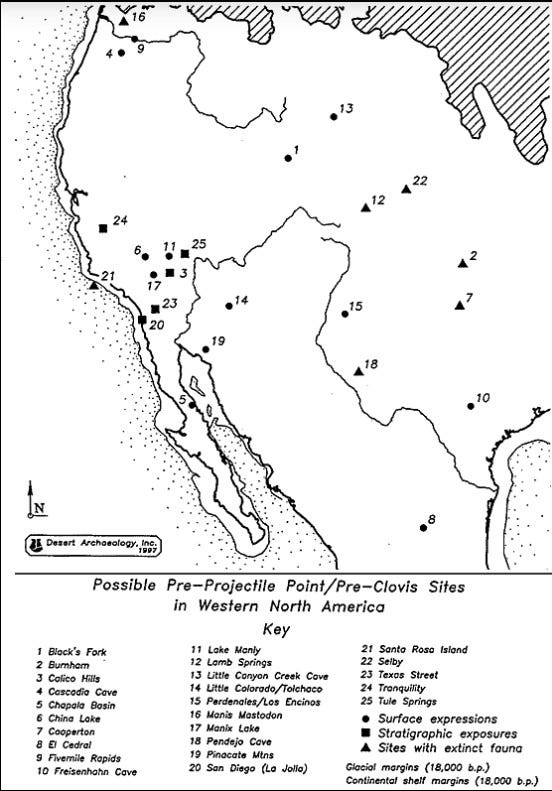
Those of us sympathetic to the notion that Monte Verde might not be a Pleistocene archaeological site knew that questioning its status would be controversial. Of course it would. But I honestly expected more dignified responses out of a group of people paid to maintain a degree of stoic discernment. You know…science professors. Instead, the Monte Verde critiques read more like school yard bickering, short on substance and heavy on ad hominen. They began in the popular media, where University of Texas archaeologist Michael Waters dismissed the study as “egregiously poor geological work” and Principle Investigator Tom Dillehay lambasted a hapless podcaster for pushing gently on his statements for all the internet to see.
The critiques didn’t improve much in the formal replies, which were submitted as non peer-reviewed “eLetters” in Science and appended to the end of the paper. The 3 letters together contained 31 authors and roughly 8 pages, the bandwagon author approach so common in debates of this sort. I’m not going to dive into them here. That’s Surovell and colleagues’ job. But I’ll give you brief impressions. Mike Waters’ letter picked at the geoarchaeology based on his and his colleagues’ egregiously poor understanding of fluvial geomorphology (See what I did there? You can just say things). Meltzer’s letter didn’t even address the study itself, just genetics.
And Tom Dillehay’s letter, accompanied by a 70 page supplement, meticulously audits Surovell and colleagues’ study, providing loads of tables and figures but no real demonstration that he actually understands the issue at hand. Bewilderingly, he also published correspondence between Surovell’s team and himself in a effort to exonerate his reputation, but only exposes himself as..…I’ll just say very rude. Those are worth a read! Most tellingly, Dillehay ends his diatribe with the following paragraph:
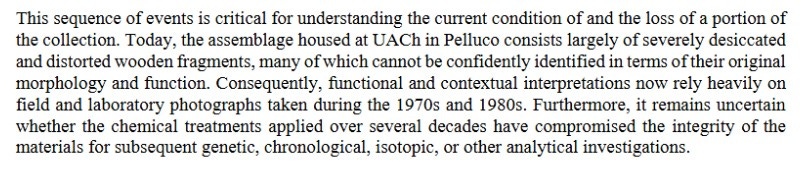
In sum, don’t bother looking into the Monte Verde collection because they no longer look like artifacts and can’t be geochemically researched. But trust me, they did at one point.
The eLetters at least clarify how these folks rationalize Monte Verde’s geology, and it’s shockingly bad for a group of 30+ people whose reputations were intended to precede them. It’s never fully explained, but they seem to believe that the site topography exists today as it existed over 14,000 years ago, with fluvial sands, peats, and other key stratigraphic markers draped across the landscape like a blanket. This is, in short, not how geology of this sort works. Serious counters to the Surovell and colleagues study would require revising fundamental principles of fluvial geomorphology, or at least identifying and explaining a novel geomorphic process that led to the creation and preservation of the Monte Verde deposit. Had they gone to this effort, then I might take them seriously. Instead, they picked at the study’s edges, nitpicking semantics and distracting the reader with tangential issues while ignoring the study’s fundamental argument: Monte Verde could not have existed 14,500 years ago on the landform where it was excavated because that landform did not exist at that time.
The pre-Clovis Caliphate
In seeking a fittingly derisive term for this bunch, a term that matches the dismissive tone of “Clovis Mafia”, caliphate feels right. Like caliphates of the Islamic world, pre-Clovis zealotry rests upon founding by one true entity, Monte Verde, upon which all subsequent claims to truth rely. There is no Islam without the prophet, no pre-Clovis without Monte Verde. And like Sharia law, pre-Clovis belief has permeated all aspects of archaeological governance, from the private donors who fund pre-Clovis excavations (actually one big one that funds them all), to peer reviewers, book authors, journal editors, and even gatekeepers to the National Academy of the Sciences. Caliphates don’t function unless we’re all on board.
But perhaps most importantly, the pre-Clovis caliphate is a faith-based tradition. The pre-Clovis archaeological record might as well be that giant black box in Meqqa. You will never see inside to independently evaluate a site or even analyze its primary data. You must instead take its contents on faith, that the movement’s supreme leaders and provincial Imams have imparted the truth honestly and accurately. And if you should get curious and peak inside, expect excommunication, a fitting punishment for apostates to the cause.
To those readers sympathetic to pre-Clovis sites: I get it, and I hope you recognize by now that I only resort to polemics when confronted with them myself. I too get excited by the prospect of an extensive Pleistocene archaeological record in the New World. However, I read each new pre-Clovis site report with eager anticipation only to be let down again and again by some barely-flaked maybe artifact or a couple of cut marked bones or a grasshopper cache or a sub-aqueous meat cache or some oddly perfect footprints or some micro-flakes at the bottom of a site or…..a turd. When all I’m asking for is a couple hundred flakes around an ancient campfire! Believe in the weird stuff if you want. I don’t care, and I’m not going to try and talk you out of it. That’s what I tell Henry from Hanna at least. I just ask that you don’t get so caught up in it that you abandon your capacity for critical thought in service to an intellectual cause that increasingly looks less like science and more like righteous conviction.
Thanks Spencer. That was a fun read. I’m smiling through the pain. I have a little different thought about the situation—call me a fence stradler. I believe that Clovis is the first “culture” in the New World, but leave open the possibility of other unsuccessful, perhaps accidental forays into the Americas that simply were here and then gone, but their presence left a scattered archaeological record. Imagine, if you will, a group of men hunting whales off the Sea of Japan. Through fluke winds they get blown a sea and somehow survive the journey into the New World. Absent women they are destined to die out but in pursuit of them they range far and wide in the New World leaving traces of their misadventure!
How would you explain the paleogenetic data in Skoglund 2016 within a “Clovis First really is right after all” framework?
I don’t think it is possible, myself, but I am interested to hear it done
Full disclosure: I do not have a yard full of crushed beer cans, use drugs, or own a pickup truck. Interesting choice of opener for an article lamenting the stigmatizing vituperative tone of …other scholars.